Material tradeoff dialogue
Carbon reinforcement
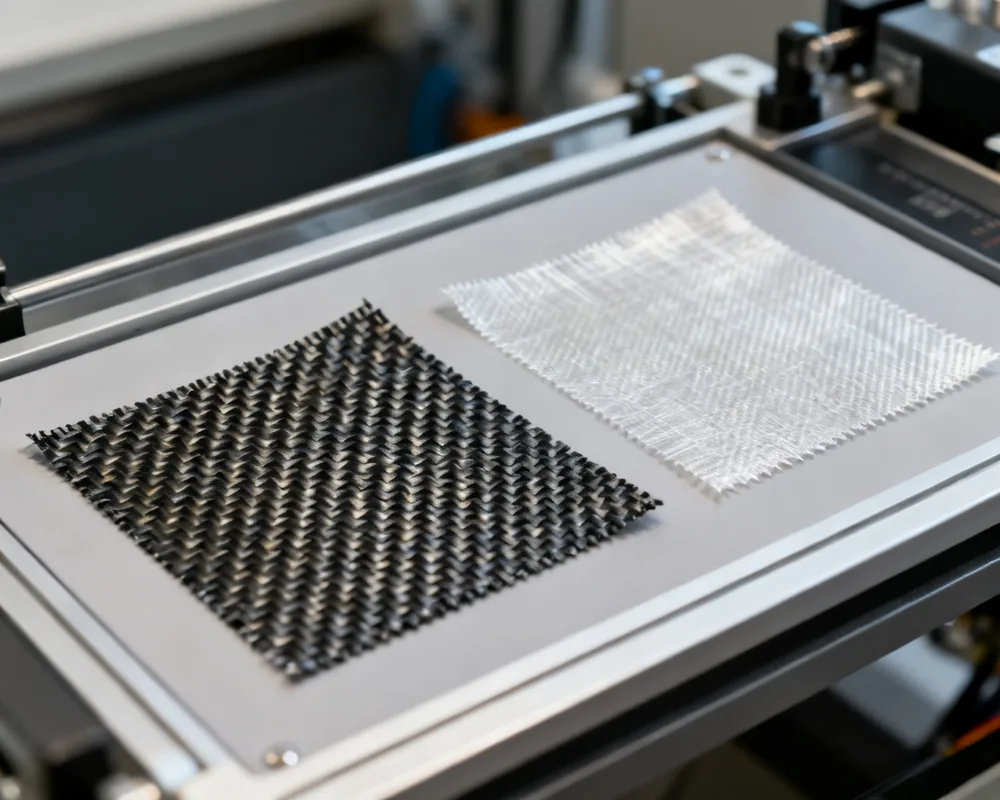
Carbon tow and carbon cloth are chosen when fiber-direction stiffness or strength is the design driver and the mass budget is tight. The tradeoff is handling: tow size, weave crimp, and sizing change drape and wet-out. A public grade name does not transfer a modulus from a strand test onto a woven ply. If the laminate must show a woven surface, that appearance constraint can outweigh a small stiffness difference between neighboring grades.
Hybrid cloth, with carbon in one direction and another fiber in another, should be specified yarn by yarn. Calling the whole textile carbon hides the second fiber and misleads both the weight calculation and any later document check.
Glass and other comparisons
Glass cloth remains a comparison when impact, cost of the fiber itself, electrical behavior, or a thicker laminate is acceptable. It is not a lesser carbon. Write the property you are willing to trade. Aramid or other yarns enter when the brief names them; this page does not expand the catalogue by association.
Dry fabric leaves resin choice and fiber volume to the infusion or wet-lay process. Prepreg fixes a resin film with the textile and moves the questions to tack, storage state, and resin content on that specimen. Those are process boundaries. They are not proof of a recovery route, a recycled-content percentage, or a corporate climate target.
Avoid a single environmental ranking
| Dimension |
Question |
| Material source |
Which fiber family is declared on this construction? |
| Processing |
Is the textile dry, bindered, or already a prepreg? |
| Use and care |
What handling and storage does that state require? |
| End-of-use route |
What recovery path is actually documented for this scrap, if any? |
If a recycled-content or sourcing statement is offered, it still needs a holder, a product scope, and a date. A fiber trademark is not that document. Leave the statement out until the paper matches the textile in the brief. The practical next step is to record the trade you accept, such as drape versus areal weight or dry infusion versus prepreg tack, and send that choice with the reference.